
 The Dojo —
None of this is complicated, and nobody expects you to arrive knowing it. Etiquette at East Wind is mostly about attention — a few shared habits that keep a room full of people training safely and seriously together.
Entering and leaving the training space
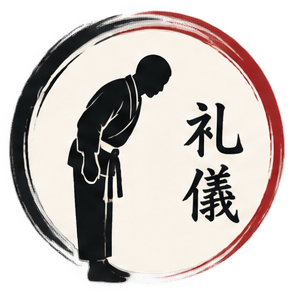
Bow to the centre of the training floor before you step on or off of it, and address your instructor as “Sensei” during class. That’s the whole rule for day one.
What follows is some of the traditional protocol and etiquette that we observe, and that will seem second nature after a class or two.
Opening class
Students line up facing the front of the room — the Sensei stands centred, facing them. All the instructors and students bow following each of these three commands:
- “Shomen ni. Rei.” — face the front of the room. Show respect and gratitude to the teachers of our teachers.
- “Sensei ni. Rei.” — face the Sensei. Show respect and gratitude to those actively passing on the art.
- “Otagai ni. Rei.” — face the person to your right or left, and acknowledge that you share a common goal of self improvement and earnest training. We say “Onegaishimasu” as we bow as an invitation to work together in harmony and mutual respect.
Addressing your seniors
Advanced students, especially those who wear black or brown belts, are addressed as “Sempai” in recognition that have journeyed further down the road of training than most. This seniority means that they may be asked to help instruct you.
The most senior students in the dojo, those of Yondan rank (4th degree black belt) and higher, are addressed as Sensei.
The head instructor for the class is always addressed as Sensei.
Some of the commands you may hear
- Rei — bow, hands resting at your sides, bending at the waist, back straight.
- Shugo — line up facing the front of the room, senior students in front, junior students behind.
- Seiza — kneel, hands resting on your thighs.
- Mokuso — close your eyes, breathe in through the nose and out through the mouth. A short reset before training starts.
- Mokuso yame — open your eyes; meditation ends.
Closing class
The bows are the same as the opening of class, but on the third bow we say “Dōmo arigatō gozaimasu” — “thank you very much” — as an acknowledgement of those who have helped us.